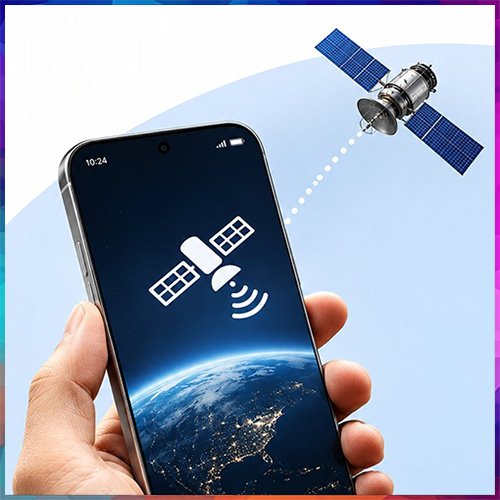
The regulator has outlined two ways for compatible smartphones to connect directly to satellites, with satellite operators supplying network capacity and authorised telecom providers offering services to consumers, subject to approval by the central government.
India’s telecom regulator has proposed a framework that would let compatible smartphones connect directly to satellites, potentially extending mobile coverage to places beyond the reach of terrestrial networks. The Telecom Regulatory Authority of India (TRAI) released its recommendations on November 5 and submitted them to the Department of Telecommunications (DoT), which will decide whether to adopt the framework.
The proposal separates the operation of satellite networks from the sale of telecom services. Satellite companies would supply network capacity to eligible service providers, while authorised telecom companies would handle services offered to consumers. That division would give satellite operators a route into India’s direct-to-device (D2D) market through agreements with telecom providers.
Separate authorisation for satellite network operators
To put that structure in place, TRAI has recommended a Satellite Communication Network (SCN) Provider Authorisation under Section 3(1)(b) of the Telecommunications Act, 2023. Companies holding it could supply Satellite Communication Network-as-a-Service (SCNaaS) to eligible providers. The authorisation would cover the supply of network capacity and would exclude direct provision of telecom services to consumers. TRAI proposed an initial term of 20 years, with an option to renew for a further 20 years.
The framework could create opportunities for companies such as Starlink, Amazon Leo, Eutelsat OneWeb and Tata’s Nelco to supply capacity. For authorised telecom providers, satellite links could become an additional service in areas where their terrestrial networks have limited reach.
Two spectrum options for handset connectivity
TRAI outlined two ways to establish a link between satellites and handsets. One would use dedicated mobile satellite service (MSS) frequencies in the L and S bands. To support that approach, TRAI recommended encouraging smartphone manufacturers to include compatible satellite communication modules in future handsets sold in India.
The second approach would use International Mobile Telecommunications (IMT) spectrum already assigned to telecom operators. TRAI identified six bands for this option, spanning 600 MHz, 700 MHz, 800 MHz, 900 MHz, 1800 MHz and 2100 MHz. The two approaches would therefore draw on different spectrum arrangements, with one using dedicated satellite frequencies and the other using frequencies assigned for mobile services.
The proposed authorisation would give satellite operators a common route to supply capacity under either spectrum arrangement. TRAI recommended allowing the IMT-based option on a non-interference and non-protection basis ahead of the World Radiocommunication Conference in 2027. Under those conditions, the satellite links would have to avoid causing harmful interference and would operate without a right to protection from interference.
The recommendations concern direct links to compatible devices. Separately, Starlink, Eutelsat OneWeb and Jio Satellite are awaiting government clearances and spectrum allocation for commercial satellite broadband services in India. The DoT’s decision on the recommendations will determine whether the proposed framework moves forward. Any commercial launch of direct-to-device services under the framework would depend on the government’s approval.

See What’s Next in Tech With the Fast Forward Newsletter







Tweets From @varindiamag
Nothing to see here - yet
When they Tweet, their Tweets will show up here.