
As AI-powered festive scams become increasingly sophisticated, FaceOff Technologies highlights the need for continuous digital trust verification across suspicious links, QR codes, public Wi-Fi networks and financial transactions.
New Delhi, October 26, 2026: The festive shopping season has become a prime opportunity for cybercriminals targeting consumers through fraudulent websites, malicious QR codes, fake payment requests and unsecured public Wi-Fi networks. With artificial intelligence making digital impersonation increasingly convincing, traditional cybersecurity awareness alone is no longer sufficient.
Cybercriminals are exploiting consumer trust through fake shopping offers, counterfeit delivery notifications, fraudulent cashback schemes and malicious payment links. A single click or QR-code scan can redirect users to phishing websites designed to steal banking credentials, personal information or authentication details.
The growing challenge is that a legitimate-looking digital interaction may still be malicious. Fraudsters increasingly use AI-generated messages, cloned websites, manipulated identities and social engineering to deceive users.
FaceOff Technologies: Moving Beyond Traditional Cybersecurity
FaceOff Technologies is developing an AI-driven digital trust ecosystem built around its proprietary Adaptive Cognito Engine (ACE®), focusing on identity verification, behavioural intelligence, deepfake detection and continuous authentication.
The company's central philosophy is simple: Never trust a digital interaction merely because it appears authentic. Continuously verify identity, context and behaviour.
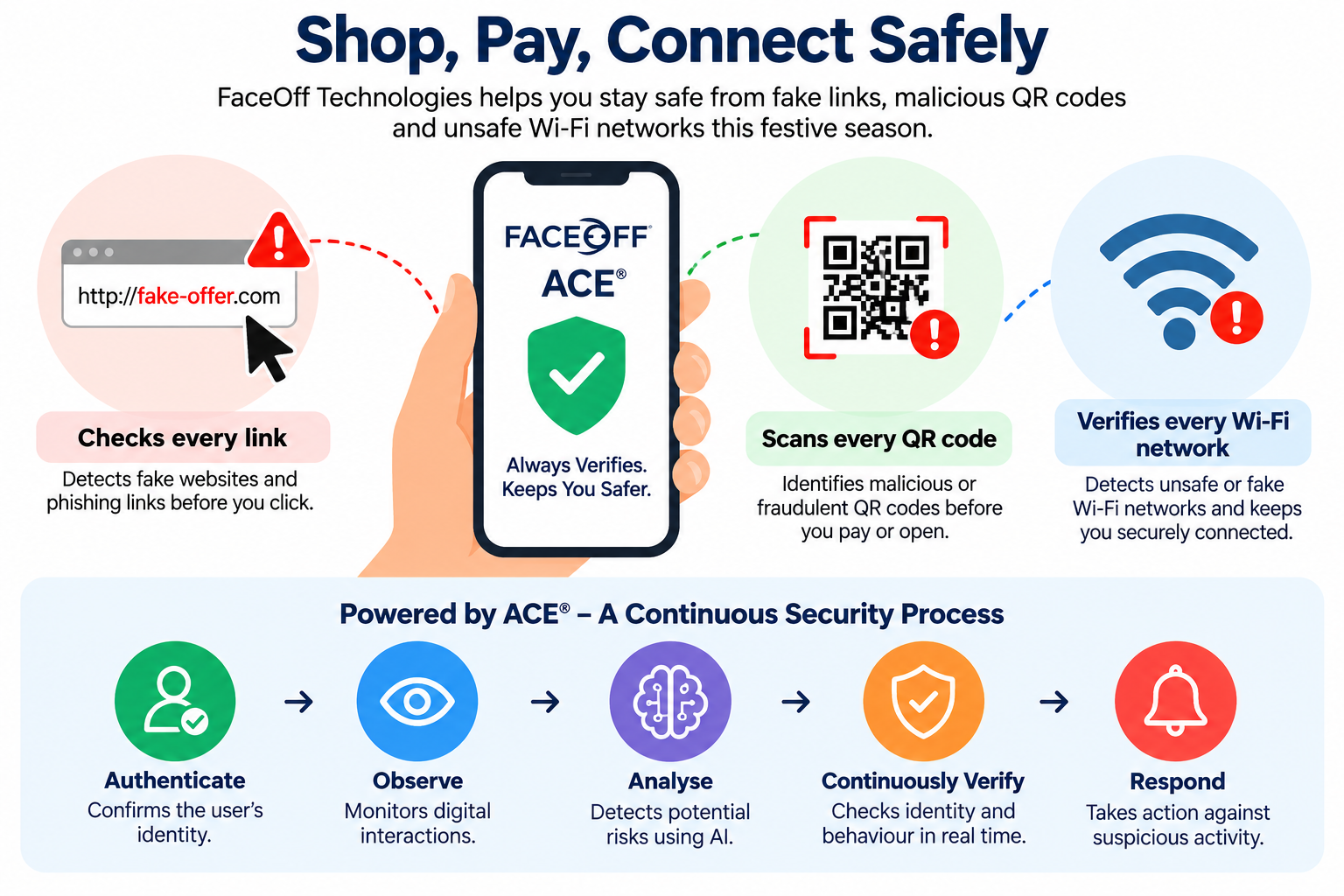
This approach is particularly relevant to three emerging consumer threats.
1. Detecting Suspicious Links and Fraudulent Websites
Cybercriminals frequently distribute malicious URLs through WhatsApp, SMS, email and social media advertisements.
A proposed integration of FaceOff's AI-driven trust framework with URL reputation services, domain intelligence and phishing detection could help assess suspicious links before users disclose credentials or complete transactions.
Such protection would evaluate domain authenticity, suspicious redirects, impersonated websites and known malicious destinations.
2. Securing QR-Code-Based Payments
QR-code fraud has emerged as a significant threat to India's digital payment ecosystem. Malicious QR codes may redirect consumers to counterfeit payment pages, fraudulent merchant accounts or credential-harvesting websites.
FaceOff's continuous identity and transaction verification capabilities could complement QR-code security checks by evaluating merchant identity, payment context and suspicious transaction behaviour.
The objective is to verify not just the QR code, but the trustworthiness of the transaction behind it.
Consumers must also remember that entering a UPI PIN authorises a payment; it is not required to receive money.
3. Protecting Users on Public Wi-Fi Networks
Free Wi-Fi networks in shopping malls, airports, hotels and public locations can expose users to rogue hotspots, phishing portals and network impersonation.
By integrating network reputation intelligence, secure connection validation and continuous authentication, FaceOff's trust architecture could help identify potentially unsafe access environments.
The emphasis is on preventing compromised connections from becoming gateways to sensitive financial information.
The USP: Continuous Trust Instead of One-Time Authentication
FaceOff Technologies differentiates its approach through multimodal AI, behavioural analysis, identity verification and risk-based decision-making.
Its ACE® architecture follows
Unlike security models that rely entirely on successful login credentials, this approach evaluates whether an interaction remains trustworthy throughout its lifecycle.
For banks, payment providers, retailers and digital platforms, such capabilities can complement conventional fraud detection and cybersecurity controls.
Dr. Deepak Kumar Sahu, Founder & CEO- Faceoff Technologies said, with the rapid expansion of UPI, e-commerce and AI-enabled digital services, India requires stronger protection against identity impersonation, fraudulent payment instructions and increasingly sophisticated social engineering.
FaceOff Technologies believes that the next generation of cybersecurity must combine AI-powered fraud intelligence, continuous authentication, transaction verification and privacy-conscious risk assessment.
The strategic message is clear: In the age of AI-powered fraud, every click, every QR code and every digital connection deserves verification before trust.
Technology clarification: FaceOff's established ACE® capabilities centre on identity, behavioural and deepfake-related trust assessment. Direct malicious-URL scanning, QR-code destination inspection and Wi-Fi threat detection are described here as potential integrations and application areas, not independently verified, currently deployed product features.

See What’s Next in Tech With the Fast Forward Newsletter








Tweets From @varindiamag
Nothing to see here - yet
When they Tweet, their Tweets will show up here.