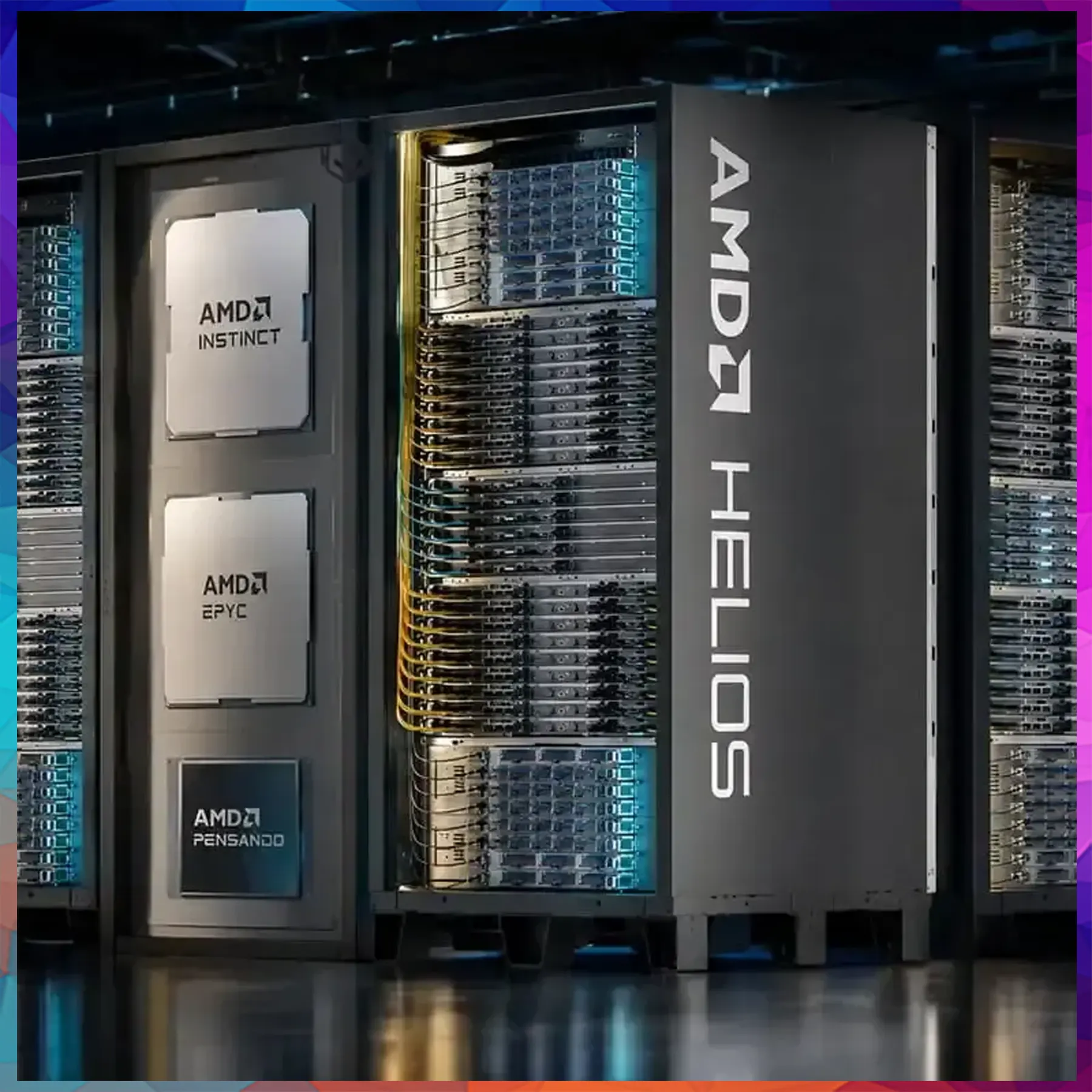
AMD's open, rack-scale architecture aims to redefine AI computing through greater performance, scalability, interoperability and infrastructure efficiency.
AMD is positioning itself at the forefront of the artificial intelligence revolution with Helios, an open rack-scale computing platform designed for AI factories, hyperscale data centers and sovereign AI infrastructure.
Key Highlights
-
Rack-scale AI computing: 72 MI455X GPUs delivering projected 2.9 exaFLOPS at MXFP4 precision.
-
Massive memory capacity: Up to 31 TB of HBM4 memory per rack.
-
Open AI ecosystem: ROCm and open networking standards aim to reduce vendor lock-in.
-
Infrastructure efficiency: Liquid cooling, EPYC CPUs and Pensando networking support high-density AI workloads.
-
Future growth opportunities: AMD targets hyperscale AI, sovereign computing, AI factories and distributed inference.
The transformation comes as global AI adoption accelerates beyond existing infrastructure capabilities. Increasing demand for model training, inference and autonomous AI applications is placing enormous pressure on computing power, networking, energy consumption and operational costs.
Developed alongside Meta and the Open Compute Project community, Helios integrates GPUs, CPUs, networking and open software into a unified architecture. AMD believes open standards will accelerate deployment, improve flexibility and reduce dependence on proprietary ecosystems.
At its core, Helios incorporates 72 AMD Instinct MI455X GPUs, delivering projected performance of up to 2.9 exaFLOPS at MXFP4 precision, alongside approximately 31 TB of HBM4 memory per rack.
AMD also highlights a projected tenfold generational performance improvement in selected AI workloads compared with MI355X platforms. These engineering estimates remain subject to validation through commercial deployments and independent benchmarking.
The platform combines sixth-generation AMD EPYC processors, Pensando networking technology and high-bandwidth GPU interconnects. Liquid cooling further supports dense computing environments where thermal efficiency increasingly determines infrastructure economics.
AMD's ROCm software ecosystem supports frameworks including PyTorch, ONNX and JAX. This open approach could improve workload portability while offering hyperscalers and enterprises greater architectural choice.
AMD anticipates industry growth driven by AI factories, distributed inference, sovereign computing and increasingly sophisticated models. Its strategy reflects an industry moving from individual accelerator purchases toward integrated, rack-scale AI infrastructure.
However, competition will depend on software maturity, deployment economics, energy efficiency and sustained customer adoption. Performance projections alone cannot establish commercial leadership against established AI infrastructure competitors.
Ultimately, AMD's ambition extends beyond faster chips. By combining open architecture, computing density and networking innovation, Helios could strengthen competition and reshape how enterprises build scalable, cost-efficient AI infrastructure.

See What’s Next in Tech With the Fast Forward Newsletter







Tweets From @varindiamag
Nothing to see here - yet
When they Tweet, their Tweets will show up here.