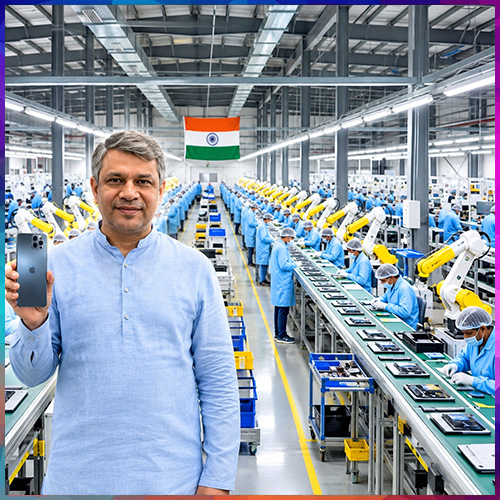
Union IT Minister Ashwini Vaishnaw says India's electronics push now extends beyond phone assembly into producing internal materials like battery cells, synthetic graphite and electrolyte additives, marking Make in India's next phase.
Union Electronics and Information Technology Minister Ashwini Vaishnaw has signalled a shift in India's smartphone manufacturing strategy, stating that the country is moving beyond simply assembling finished devices toward producing the internal components and raw materials that go into them.
In a post on social media platform X, Vaishnaw said India has already established itself in phone assembly and is now focused on building capacity for the materials used inside these devices, describing it as the next stage of the government's Make in India initiative.
Battery ecosystem expands beyond cell manufacturing
According to the minister, one of the key growth areas is battery manufacturing, with lithium-ion battery cells already being produced domestically. He said India is now pushing further down the battery supply chain, citing synthetic graphite — a material used in battery anodes — as a component that will increasingly be manufactured within the country.
Vaishnaw also pointed to other specialised materials entering domestic production, including additives used in liquid electrolytes to enhance battery performance and lifespan, as well as acetylene black, a material that improves electrical conductivity inside battery cells. He described such materials as small in size but significant in function within the overall battery ecosystem.
Wider component manufacturing beyond batteries
The minister said this deepening of domestic manufacturing is not limited to batteries alone. Components such as cameras, displays, speakers, coils, device enclosures, printed circuit boards and connectors are increasingly being produced within India as well, reflecting what he called a broader movement into the electronics value chain.
Vaishnaw's remarks come against the backdrop of India's expanding smartphone manufacturing footprint over the past ten years. The country has emerged as the world's second-largest smartphone producer, manufacturing approximately 330 million units annually. Official figures show that in the 2023-24 financial year, 99.2 per cent of mobile phones sold domestically were manufactured within India, a sharp rise from just 26 per cent a decade earlier.
The minister also referenced a battery-cell manufacturing facility operated by ATL in Manesar, Haryana, representing an investment of approximately ₹3,000 crore.
Separately, the government has rolled out a ₹62,500-crore Mobile Phone Manufacturing Scheme, designed to run over five years from FY2026-27 through FY2030-31. The scheme offers manufacturing incentives ranging between 2.25 per cent and 5 per cent, with additional support earmarked for Indian brands as well as design and research and development activities.
Taken together, Vaishnaw's comments reflect a broader narrative shift in India's electronics sector — from positioning the country primarily as an assembly hub to building a more comprehensive domestic ecosystem covering components, materials and sub-assemblies used in smartphone production.

See What’s Next in Tech With the Fast Forward Newsletter









Tweets From @varindiamag
Nothing to see here - yet
When they Tweet, their Tweets will show up here.